The Helping Angel — Reetha as a Natural Hair Wash
HELPING ANGELS
The Helping Angel — Reetha as a Natural Hair Wash
By Michaya Angel · 22 November 2026 · approx. 7 min read
Cleaning naturally.
Discovering the power of plants.
Trying a different approach to haircare.
✦✦✦
What This Text Is About
- Reetha
- Ritha
- soapnut
- Sapindus mukorossi
- natural hair washing
- saponins
- oily scalp
- sebum
- Ayurvedic haircare
- shampoo alternative
After Shikakai and Amla, today I want to introduce the third plant that appears again and again in traditional haircare:
Reetha.
It is sometimes also called:
Ritha
Aritha
or simply:
soapnut.
And the name already tells us quite a lot.
Because Reetha really can wash.
The fruit shells contain natural saponins, which are responsible for their cleansing effect.
Among Ayurvedic plant powders, Reetha is therefore something like the stronger cleansing specialist.
What Exactly Is Reetha?
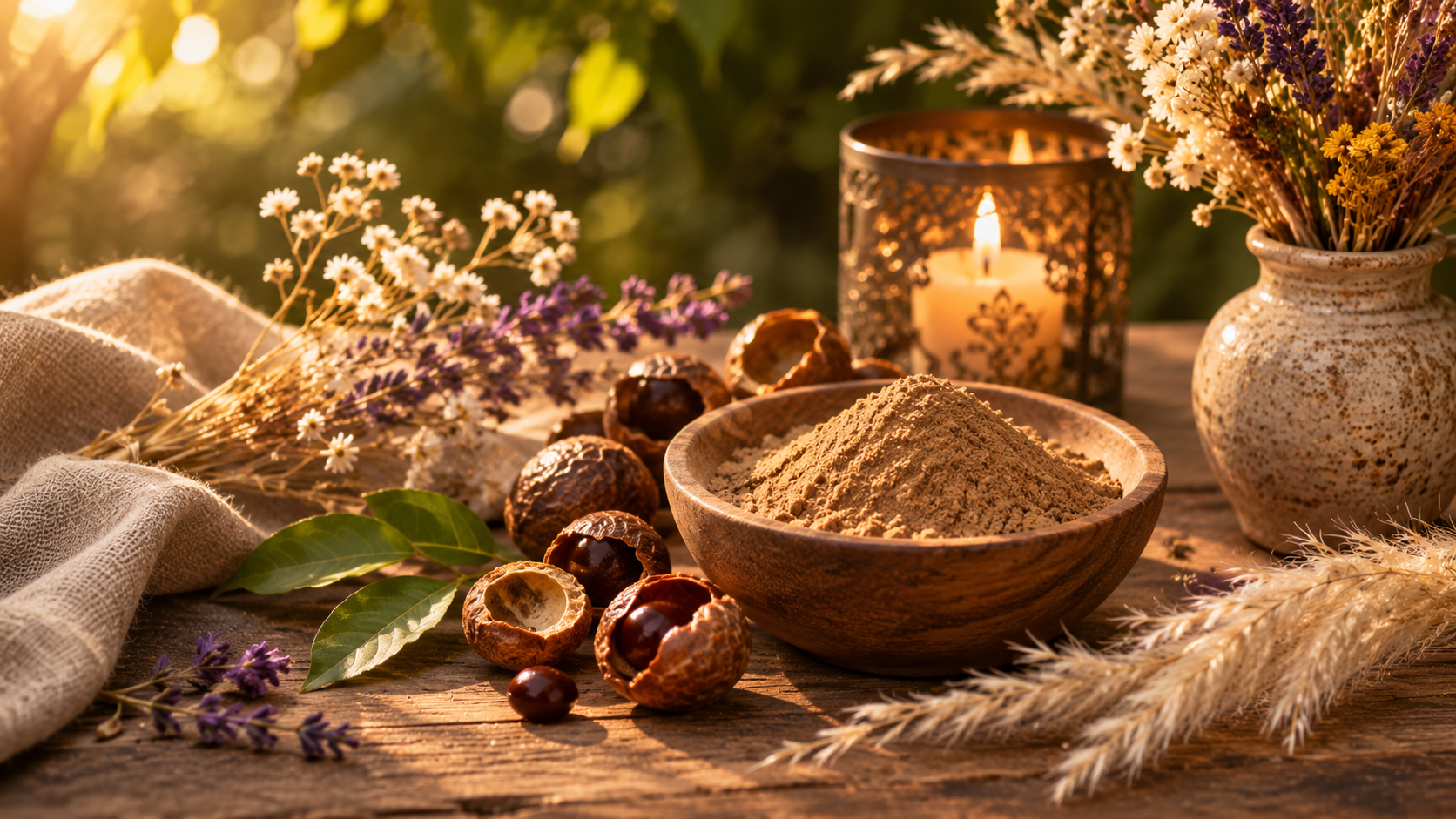
Reetha usually comes from Sapindus mukorossi, a tree belonging to the soapberry family.
Its fruits have a firm shell.
And it is precisely this shell that is rich in saponins.
Traditionally, soapnuts were used not only for body and haircare, but also for washing textiles.
So the name soapnut is rather fitting.
What Is in Reetha?
The most important components for washing hair are the saponins.
These are natural plant compounds with surface-active properties.
They can reduce the surface tension of water.
This allows water and oil to combine more easily.
Put simply:
The saponins help loosen excess skin oils and dirt from the hair and scalp.
Modern studies confirm these cleansing properties of Sapindus saponins.
That is exactly why they are now even being investigated as plant-based surfactants for cosmetic products.
What makes Reetha Special
- contains plenty of natural saponins
- can help loosen excess oil and dirt
- produces foam when mixed with water
- has a long tradition as a natural hair wash
- works well in plant-based shampoo mixtures
Reetha Really Does Foam
With natural hair washing, there is one thing many people initially miss:
Foam.
Rye flour barely foams.
Lava clay does not either.
And Shikakai does not necessarily create the familiar shampoo feeling many people are used to.
Reetha is a little different.
Its saponins can actually produce visible foam.
Of course, not necessarily as much as a strongly foaming conventional shampoo.
But noticeably more than many other plant powders.
And here, the foam actually has a functional basis:
It is created by the plant’s natural surfactants.
Does Reetha Clean More Strongly Than Shikakai?
In my experience, Reetha is the stronger cleansing option.
Shikakai, on the other hand, feels like a milder plant wash to me, with an additional conditioning character.
So the two plants have different strengths.
That makes Reetha particularly interesting for:
quickly oily roots
heavier sebum
build-up
or when a plant-based wash has not cleansed thoroughly enough so far.
With very dry hair or a sensitive scalp, however, I would start slowly.
Reetha and an Oily Scalp
This area is actually scientifically interesting.
In a more recent study, a shampoo containing an extract from Sapindus mukorossi was tested.
After four weeks, a noticeable reduction in scalp sebum was measured.
What was interesting was this:
Skin hydration and water loss through the skin barrier did not worsen in that study.
Of course, that does not mean that a homemade Reetha paste will have exactly the same effect as the shampoo formulation that was studied.
But the results are interesting because they show that Reetha, or Sapindus extracts, may also be a promising area of research for oily scalps.
Reetha and the Scalp
Alongside saponins, Reetha also contains other plant compounds such as polyphenols and flavonoids.
In research, Sapindus extracts are being investigated for properties including:
antimicrobial
antioxidant
and inflammation-related effects.
There is also some interesting newer research involving the scalp.
One study using a fermented filtrate made from soapnut shells looked at the human scalp microbiome.
The composition of microorganisms on the scalp changed, which may potentially have a positive effect on its balance.
However, that is something different from a simple Reetha paste.
So I would not turn this into the claim:
“Reetha restores the scalp microbiome.”
But the results do show that the plant is scientifically interesting beyond its cleansing effect alone.
Sometimes the shampoo is not in the bottle —
but already inside the shell of a fruit.
Can Reetha Help with Dandruff?
Reetha is traditionally also used for dandruff.
To me, that does make some sense.
If excess sebum and build-up play a role, Reetha’s cleansing effect may help improve the way the scalp feels.
Reetha saponins are also being studied for their antimicrobial properties.
However, the evidence for Reetha alone as a treatment for dandruff is much thinner than advertising sometimes suggests.
Interesting results are found especially in plant-based combination formulations where Reetha is used together with plants such as Neem, Shikakai, Aloe, or Amla.
So I would say:
Reetha may support the care of a scalp that tends to become oily and flaky.
An inflamed, severely itchy, weeping, or persistently flaky scalp should still be medically assessed.
And What About Hair Growth?
With Reetha, you will also often come across the claim:
“promotes hair growth.”
Here I would be considerably more cautious than with Amla.
Reetha’s main strength lies in cleansing the scalp.
A clean, balanced scalp creates good conditions for healthy hair.
Reetha may contribute to that thorough cleansing.
A direct hair-growth-promoting effect in humans has not yet been sufficiently established.
Is Reetha Very Drying?
It certainly can be.
Precisely because Reetha cleans quite effectively, using too much may be excessive for dry hair or a sensitive scalp.
So I would not follow the principle:
More powder = cleaner = better.
With Reetha especially, less is sometimes more.
If your hair feels dull, rough, or dry afterwards, you can:
use less Reetha,
shorten the application time,
or mix Reetha with Amla or Shikakai.
Personally, I almost always mix Reetha with the other powders because
I prefer the combination for my hair and scalp over a stronger Reetha wash on its own.
Reetha Hair Wash — How to Use It
Ingredients
1–2 tbsp Reetha powder
warm water
If your scalp is sensitive or dry, I would begin with 1 tablespoon.
Preparation
- Place the powder in a small bowl.
- Gradually add warm water.
- Mix until you have a relatively fluid paste that is still easy to distribute.
- You can let the mixture sit for a few minutes.
- This allows the saponins to disperse more thoroughly in the water.
How to Use It
- Wet your hair thoroughly.
- Apply the Reetha mixture mainly to the scalp and roots.
- Massage it in gently.
- Then rinse thoroughly with lukewarm water.
- If your hair is very oily, you can repeat the process if necessary.
- But I would first see whether one round is already completely sufficient.
Avoid Getting It in Your Eyes
As with Shikakai:
Reetha should ideally not get into the eyes.
Saponins can cause strong irritation there.
So take a little extra care during application and rinsing.
If any gets into your eyes, rinse thoroughly with clean water.
Reetha Made from Whole Soapnuts
Reetha is not only available as a powder.
You can also buy whole dried soapnut shells.
These can be boiled in water.
The saponins then pass into the water.
The resulting liquid can be used as a natural washing solution.
For hair, however, I often find powder easier because you can mix exactly the amount you need.
Reetha + Shikakai
In my view, these two plants complement each other very well.
Reetha provides more thorough cleansing, while Shikakai makes the mixture somewhat milder.
This allows you to combine the properties of both plants.
For example:
1 part Reetha
with
2 parts Shikakai
mixed together.
If your scalp is very oily, you can increase the proportion of Reetha.
With a dry scalp, reduce it instead.
Reetha + Amla
I also like this combination.
Because Amla brings a stronger conditioning component.
For example:
1 tbsp Reetha
1 tbsp Amla
and warm water.
If you also add Shikakai, you get a lovely combination of cleansing and care.
Cleansing + milder cleansing/care + plant treatment.
The three plants complement one another beautifully:
Reetha: for more thorough cleansing
Shikakai: for a milder plant wash
Amla: as an additional conditioning component
Of course, you do not have to use all three.
What matters is which combination suits your hair and scalp best.
How Often Can You Use Reetha?
That depends on your scalp.
For oily hair, Reetha may work well on a regular basis.
If your scalp is dry or sensitive, I would use it less often or mix it with Shikakai and Amla.
What matters is:
How does your hair feel afterwards?
Clean and light?
Or dry and dull?
Does your scalp feel tight?
Or does it feel comfortable?
The right haircare routine is often found less through rigid rules and more through observation.
Natural cleansing can be thorough — without having to become complicated.
How Much Does Reetha Cost?
Reetha is priced roughly at the same level as other Ayurvedic hair powders.
At one specialist supplier, Ritha powder currently costs around €6.50 per 100 g.
Depending on the manufacturer, pack size, and source, prices may of course be lower or higher.
Larger packs are often cheaper when calculated per 100 grams.
How Much Does One Hair Wash Cost?
With around 15 g of powder per application and a price of roughly €6.50 per 100 g, one Reetha hair wash costs approximately:
€1.
If you mix Reetha with Shikakai or Amla and therefore use less of it, the cost can be lower.
That makes Reetha considerably more expensive than washing with rye flour.
But still within a fairly manageable range.
What Would I Look for When Buying Reetha?
Here too, I would keep things as simple as possible.
The product should say:
100% Reetha
or:
Sapindus mukorossi
without unnecessary fragrances or additional ingredients.
A finely ground powder is also much more pleasant to use for washing hair.
Who Might Find Reetha Interesting?
Reetha may suit you particularly well if you:
- have roots that become oily quickly
- are looking for a stronger plant-based wash
- do not get enough cleansing from Shikakai alone
- want to reduce your use of conventional shampoos
- or would simply like to try natural saponins.
With very dry or sensitive hair, however, I would begin with a mixture containing a smaller proportion of Reetha.
Is Reetha Better Than Shikakai?
Not necessarily. The two plants have different strengths.
For me, Shikakai is the gentler option,
while Reetha cleans more thoroughly.
Amla complements both with an additional conditioning component.
Which combination works best ultimately depends on your scalp and your hair.
My Conclusion
Reetha shows how plants were already being used quite naturally for washing long before modern shampoos existed.
And its effect is not mysterious at all:
The shells contain saponins, natural plant compounds that can loosen oil and dirt.
I find Reetha particularly interesting for roots that become oily quickly, or when a milder plant-based wash does not cleanse thoroughly enough.
For me, the three plants complement one another beautifully:
Reetha for more thorough cleansing.
Shikakai for a milder plant wash.
Amla for additional care.
You do not need a complicated system. What matters is what your own scalp needs.