The Helping Angel — Amla for Hair and Scalp
HELFENDE ENGEL
The Helping Angel — Amla for Hair and Scalp
Von Michaya Angel · 23. November 2026 · ca. 7 Min. Lesezeit
Haircare from a fruit.
Discovering the power of plants.
Supporting scalp and hair naturally.
✦✦✦
What This Text Is About
- Amla
- Indian gooseberry
- Ayurvedic haircare
- hair growth
- hair loss
- scalp
- antioxidants
- tannins
- plant powder
- natural haircare
After introducing rye flour, lava clay, and Shikakai, there is one more plant that definitely deserves a place in this series:
Amla.
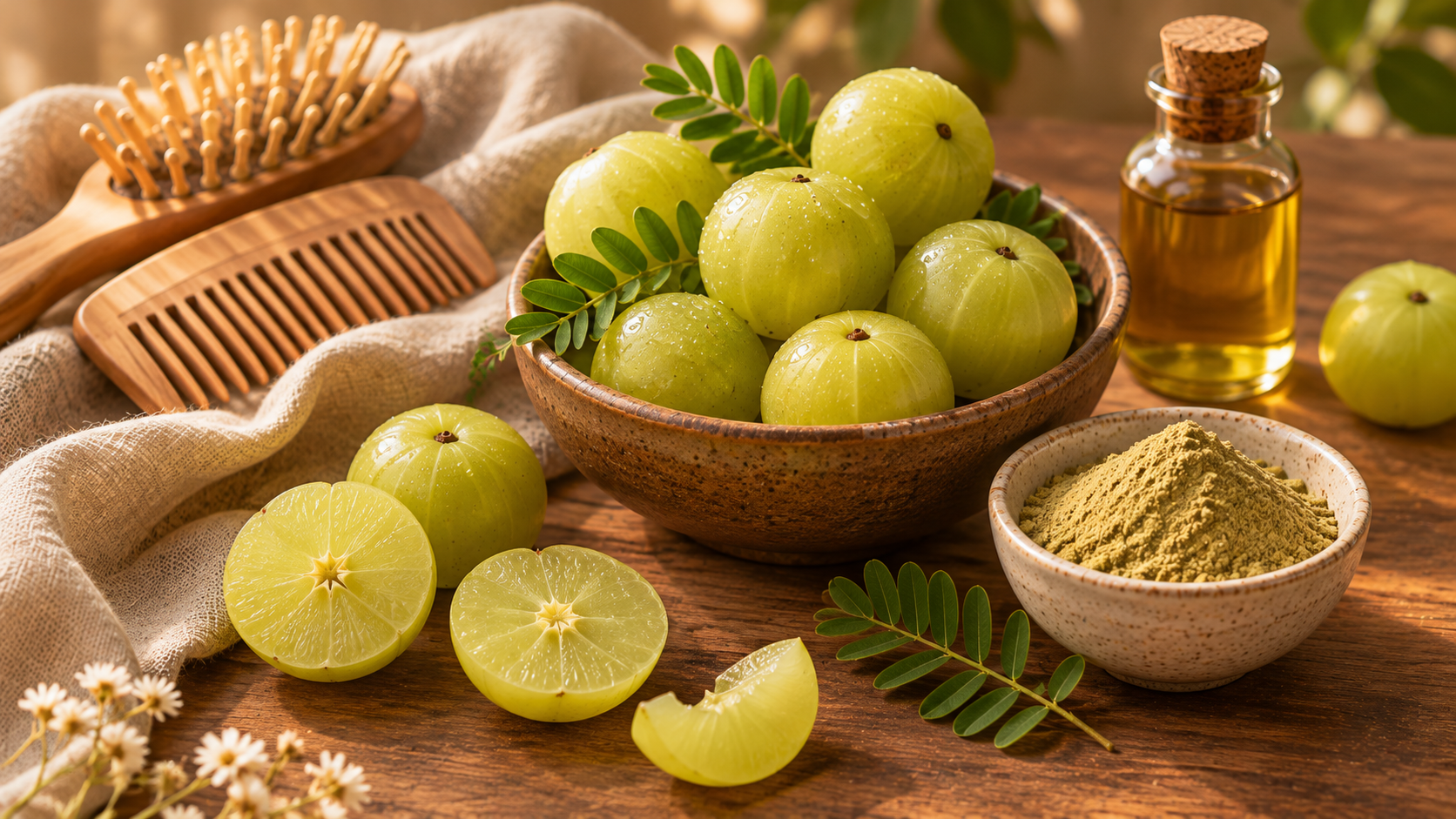
Amla is also known as Indian gooseberry and is one of the best-known plants in traditional Ayurvedic haircare.
The fine powder is made from the dried fruits of Phyllanthus emblica.
Unlike Shikakai or Reetha, Amla is not primarily used for cleansing, but for care.
Indian gooseberry has traditionally been used for both hair and scalp and is said to support strong, shiny hair.
Amla is especially valued as a conditioning plant.
It has traditionally been used for hair and scalp and is said to support strong, glossy hair.
What I find particularly interesting is this:
There are now even some early scientific indications that Amla may support hair growth.
Of course, it is not quite as simple as saying:
“Amla makes your hair grow.”
But it is worth taking a closer look.
What Exactly Is Amla?
Amla is the fruit of the tree Phyllanthus emblica, which grows mainly in South and Southeast Asia.
The small greenish-yellow fruits are very sour and rich in a variety of plant compounds.
Amla has long been used in traditional Indian medicine.
Not only as a food.
But also for skin and hair.
For haircare, the dried fruit is finely ground.
The result is a light brown to greenish-brown powder that can be mixed with water to form a paste.
What Is in Amla?
Amla contains a whole range of interesting plant compounds.
These include:
polyphenols
tannins
flavonoids
and various organic acids.
The antioxidant properties of the fruit have been studied particularly closely.
Gallic acid is also among the compounds that have been detected in Amla extracts.
In one study involving Amla and hair follicles, gallic acid was even one of the main components of the aqueous extract that was used.
That may sound rather scientific at first.
Put simply, it means:
Amla contains plant compounds that may help protect cells from oxidative stress and are therefore also of interest in hair and scalp research.
What Makes Amla Particularly Interesting
- rich in antioxidant plant compounds
- traditionally used in Ayurvedic haircare
- can be used as a hair mask or scalp treatment
- may give hair more body and structure
- combines well with Shikakai and Reetha
Can Amla Support Hair Growth?
This is where the research becomes especially interesting.
With Amla, there is actually more than traditional experience alone.
Laboratory and animal studies suggest that Amla extracts may influence processes connected with hair growth.
In one study, an aqueous Amla extract activated genes associated with hair growth in human keratinocytes.
Reviews also describe experimental evidence suggesting that Amla may influence hair follicle activity and may possibly inhibit the enzyme known as 5-alpha-reductase.
This enzyme plays a role in certain forms of hormone-related hair loss.
And there is even a human study.
In a randomised study involving women with androgenetic hair loss, an orally consumed Amla syrup improved the ratio of hairs in the growth phase to hairs in the resting phase after twelve weeks compared with placebo.
I find that remarkable.
But one point is important:
This study looked at Amla taken orally — not Amla powder used as a hair mask.
So we cannot automatically conclude that applying Amla paste to the scalp will have the same effect.
The findings so far make Amla scientifically interesting as well.
Whether these results can be transferred to topical haircare, however, still needs to be studied more closely.
Amla and Hair Loss
Amla is often marketed as a remedy for hair loss.
But it is not quite that simple.
Hair loss can have many different causes:
- hormonal changes
- iron deficiency
- thyroid problems
- stress
- medications
- inflammation
- genetic factors
That is why hair loss cannot simply be treated with a single plant.
If hair loss becomes suddenly severe or continues for a longer period, the cause should be medically assessed.
Amla can be a lovely addition to a haircare routine. But it does not replace targeted treatment.
Healthy hair does not begin only in the lengths — it also begins with a well-cared-for scalp.
Amla and the Scalp
Amla is also interesting when it comes to scalp care.
In laboratory studies, Amla extracts have been investigated for antimicrobial and antifungal properties.
Among other things, activity has been observed against Malassezia, a yeast that can play a role in certain forms of dandruff.
That does not mean, however, that a homemade Amla paste will automatically treat dandruff.
Rather, these studies show that Amla’s plant compounds are also of interest in scalp research.
A plant mask can complement scalp care.
With a sensitive or easily irritated scalp, however, I would still begin with a small amount.
Because even natural plant compounds can cause irritation in some people.
Amla for Shine and Stronger-Looking Hair
Amla is traditionally also used to make hair appear stronger and shinier.
This is less about biologically “repairing” damaged hair.
Hair cannot actually do that.
But plant powders can affect the surface of the hair.
After use, the hair may feel or appear:
more textured
fuller
and sometimes shinier.
Fine hair in particular can sometimes gain a little more structure after a plant treatment.
With very dry hair, however, I would not leave Amla on for too long and might combine it with a more conditioning ingredient.
Can Amla Prevent Grey Hair?
This is another claim you will often come across.
In Ayurvedic tradition, Amla is strongly associated with maintaining dark, strong hair.
From this came the idea that Amla could prevent premature greying.
However, there is currently not enough strong evidence in humans to support that claim conclusively.
So I would not write:
“Amla prevents grey hair.”
I find this wording more accurate and honest:
Amla is traditionally used to care for strong, pigmented hair.
That preserves the tradition without turning it into a promise.
Amla Is Not a Shampoo
One important difference compared with Shikakai and Reetha is the cleansing effect.
Amla contains considerably fewer cleansing saponins than those two plants and is therefore better suited as a:
- hair mask
- scalp treatment
- addition to a plant-based hair wash
If your hair is noticeably oily, Amla alone may not be enough. In that case, you can combine it with Shikakai or Reetha.
Amla Hair Treatment — How to Make It
Ingredients
2–3 tbsp Amla powder
warm water
For long or very thick hair, use correspondingly more.
Preparation
- Place the Amla powder in a bowl.
- Slowly add warm water.
- Mix everything until a creamy paste forms.
It should not drip, but should still be easy to spread.Sie sollte nicht tropfen, sich aber gut verteilen lassen.
How to Use It
- You can apply the paste to slightly damp hair and scalp.
- Spread it gently and leave it on for a few minutes.
- To begin with, I would recommend: 10–20 minutes
- and then gradually finding the amount of time that suits you best.
- Afterwards, rinse very thoroughly with water.
If your hair is very dry, you can shorten the application time or combine Amla with a more conditioning ingredient.
Combining Amla with Shikakai
I particularly like this combination.
Because the two plants have different roles.
Shikakai cleans.
Amla conditions.
For example, you can mix:
1 tbsp Shikakai with 1 tbsp Amla and add warm water to make a paste.
This combines Shikakai’s cleansing properties with Amla’s conditioning effect.
Combining Amla with Reetha
If you want a little more cleansing power, you can also combine Amla with Reetha.
Reetha contains considerably more saponins and therefore has stronger cleansing properties.
A simple mixture could be:
1 part Reetha
1 part Amla
With a sensitive or rather dry scalp, I would begin with a smaller proportion of Reetha.
Amla is mainly for care — not cleansing.
- For a pure treatment, you can use Amla on its own.
- For washing hair, it combines beautifully with Shikakai or Reetha.
How Much Does Amla Cost?
Amla powder is generally fairly inexpensive.
Prices can vary considerably, however, depending on the supplier, quality, and pack size.
In Germany, for example, you can currently find prices of around:
€1.30 per 100 g in Indian grocery shops,
around €3.50–€5.50 per 100 g from various suppliers,
and up to approximately
€6.50–€7.30 per 100 g from specialised natural cosmetics or Ayurveda brands.
Prices can of course change.
If you use plant-based haircare regularly, larger packs can often be more economical.
How Much Does One Treatment Cost?
Let us assume around 20 g of Amla powder for one treatment.
With powder costing roughly €3–€7 per 100 g, one application costs approximately:
€0.60–€1.40.
With cheaper packs from Indian grocery shops, it can cost considerably less.
That makes Amla quite affordable in my view, especially as an occasional hair treatment.
What Would I Look for When Buying Amla?
I would choose a powder whose ingredient list contains only:
Phyllanthus emblica
or:
100% Amla fruit powder.
The fewer additional ingredients there are, the easier it is to see how your hair responds to the plant itself.
I would also look for a powder that is ground as finely as possible.
Coarse plant material is much harder to rinse out of long hair.
And anyone who has ever spent twenty minutes combing tiny pieces of plant matter out of their hair knows:
That is not necessarily an experience you want to repeat.
Who Might Find Amla Interesting?
Amla may suit you particularly well if you:
- want to care for your hair with plant-based ingredients
- have fine or weak-looking hair
- want to give your scalp some additional care
- are interested in Ayurvedic haircare
- or want to complement Shikakai or Reetha with a conditioning plant.
Sometimes natural haircare does not need much at all — just the right plant, a little water, and a little time.
My Conclusion
I find Amla especially interesting because it has such a long tradition in Ayurvedic haircare while also containing plant compounds that are scientifically interesting.
Whether an Amla hair mask can actually influence hair growth has not yet been sufficiently established.
But as a conditioning addition for hair and scalp, I find the plant very interesting.
I especially like the possibility of combining Amla with other plant powders.
Shikakai cleans gently.
Reetha cleans more thoroughly.
Amla adds care.
Three plants. Three different properties.
And perhaps that is exactly why this combination has held a place in Ayurvedic haircare for such a long time.
And sometimes good haircare really does not need anything more.